

When AI must provide answers based on extensive or frequently changing information, traditional models often fall short. RAG (Retrieval-Augmented Generation) solves this problem. It allows AI to generate answers based on external sources, such as documents, databases or internal knowledge bases, even if the AI has not been trained on that information.
How does RAG work?
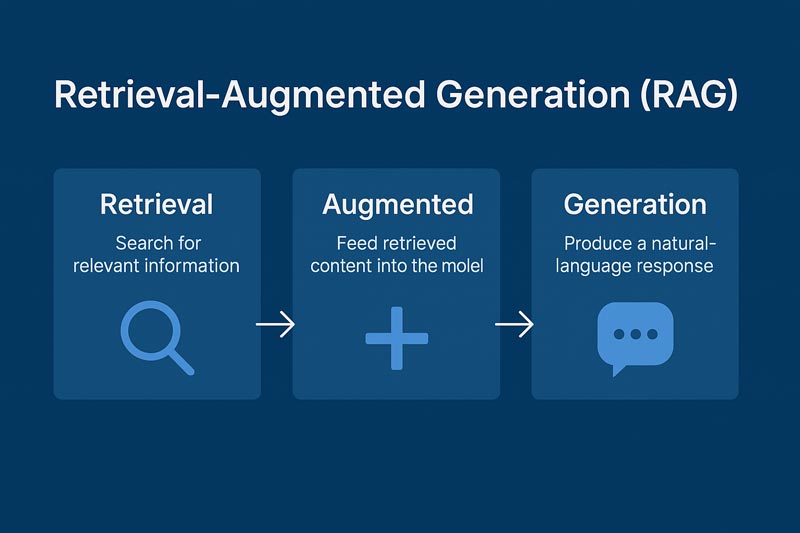
RAG consists of three steps:
- Retrieval:the AI first searches for relevant information from linked sources, such as policy documents, manuals or internal FAQs.
- Augmentation:the retrieved information is added to the AI model as additional context. This is what makes RAG special. The model does not just rely on what it “knows” from training, but receives enriched, current information to base a response on.
- Generation:with this combination of linguistic capabilities and retrieved data, the AI generates a natural-sounding answer.
In short, RAG = Retrieval + Enriched Context + Generation.
Thanks to this augmentation step, the AI remains accurate, context-aware and aligned with your current knowledge without the need to retrain the model.
Why is this important?
Without RAG, AI relies only on what it learned during training, which is often outdated or too general. With RAG:
- Keeps the AI up-to-date,
- Can work with organization-specific content,
- Get answers that are not only globally correct, but factually correct based on your own sources.
Cost-effective and scalable
One of the biggest advantages of RAG is cost efficiency. Traditional AI models require extensive retraining or fine-tuning to add new knowledge. That's time-consuming and expensive. With RAG, you can adjust the underlying knowledge simply by changing the external sources from which the model draws information. This allows you to scale and update your AI solution without high operational costs. Instead of constantly modifying the model, you modify the content. This makes RAG a sustainable and budget-friendly solution for dynamic or growing organizations.
Practical examples
- Employee asks about home work policy
An employee asks, “How many days can I work from home?”
Thanks to RAG, the AI retrieves the latest HR policies and responds:
“According to the March 2024 home work policy, you may work from home up to 3 days a week in consultation with your supervisor.” - Customer asks for accounting software
A customer asks, “Does your accounting package support multiple entities? And what does it cost?”
The AI retrieves information from the product brochure or price list and responds:
“Yes, our accounting software supports multiple entities within one account. The standard license costs €39 per month, including support and updates.” - User asks how to reset his password
A user asks, “How do I reset my password?”
The AI searches the internal IT support documentation or FAQ and answers:
“You can reset your password from the login page by clicking on ‘Forgot your password.’ You will then receive an e-mail with a reset link. If you do not receive it within a few minutes, please contact IT support.”
RAG versus traditional AI responses
| Without RAG | With RAG |
|---|---|
| Based on training data only | Based on current internal information |
| Vague or general answers | Specific and substantiated answers |
| Not transparent | Traceable to original documents |
Reliable AI with access to your knowledge
RAG is ideal for organizations that want to use AI as a smart assistant, with control over the information used. Whether it's HR, IT, product documentation or details of your services, RAG ensures that your AI has access to the right knowledge at the right time, without having to build everything into the model itself.


