

“With AI, we want smart automation without losing human contact.”
Sagar Schoneveld (Managing Director at Conversed.ai) talks with Perry Groenenberg (Director and shareholder at Flanderijn) about the use of AI within the organization, the step-by-step automation of processes, and why a thoughtful approach is so important, especially in a people-centric field.
At Flanderijn everything revolves around the careful handling of payment arrears, collections, and legal cases. In a sector where laws and regulations, compliance, and human contact play a significant role, the organization is also explicitly looking at the possibilities of AI.
We spoke with Perry Groenenberg about his vision for AI, the development of AI assistants Flower and the collaboration with Conversed.ai.
“We are looking very practically at where AI adds value”
Perry Groenenberg is managing director and shareholder at Flanderijn, primarily focusing on operations, process management, and translating business needs into IT solutions.
Flanderijn operates in the Netherlands and Belgium and specializes in early detection, relationship restoration, social debt collection, bailiff services, and debt collection. As such, the organization operates in an industry where accuracy, reliability, and diligence are essential.
“We primarily take a very practical approach to AI,” says Perry. “Where does it truly add value? Where does it save time? And where does it make processes smarter without you losing control?”
That pragmatic starting point also forms the basis of the AI approach within Flanderijn.
AI as a tool for more efficient customer contact
Like many organizations, Flanderijn quickly realized that there was a lot of repetitive work in daily operations.
“You just realize that a lot of the manual work is inefficient and time-consuming,” says Perry. “So you automatically start asking yourself: how can we organize things more efficiently?”
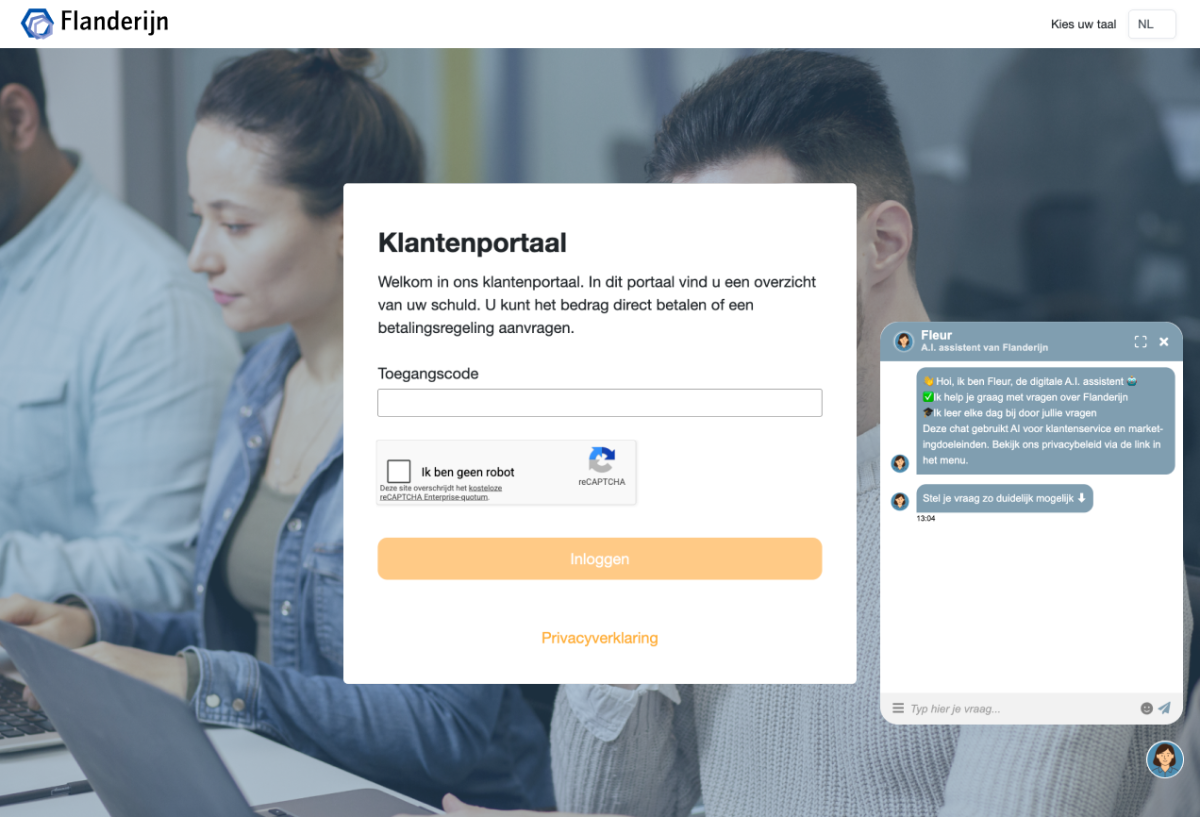
From that idea, the first step with AI also arose: a digital assistant within the customer portal.
The assistant was named Flower and assists customers with initial inquiries, such as those regarding account balances, payment arrangements, or access to the portal.
“The idea was to start small and manageable,” Perry explains. “Not everything at once, but first one clearly defined project that you can execute well.”
Flower as the first step
According to Perry, the choice to start with a relatively compact user case proved to be exactly the right one.
“We deliberately didn't start too big,” he says. “I'm really glad about that in hindsight. Because as soon as you implement AI in an organization, you naturally encounter how much testing, integration, and alignment is involved.”
AI assistant Fleur is currently being further developed, and work is also underway on integrations with backend systems, so that customers can be helped even more effectively in the future.
“For example, if someone asks what the outstanding balance is, we don't just want to answer generally, but ultimately be able to retrieve it directly from the system. These are precisely the things where AI in combination with system integrations adds a lot of value.”
Start small, test thoroughly, then scale up.
For Perry, that is also the most important lesson for other organizations that want to get started with AI.
“Think carefully beforehand about what exactly you want to solve,” he says. “Develop a good business case, choose one subject, and work it out thoroughly. Test it, see what it does, and only then put it into production.”
According to him, things often go wrong in practice when organizations try to do too much at once.
“We currently have several AI projects underway, and you immediately notice how much work is involved. You want speed, but in practice, you spend a lot of time on testing, integrations, compliance, and embedding it properly within your organization.”
His advice is therefore clear: focus first on the biggest and most promising applications.
“Above all, focus on the topics with high volume and where you can achieve quick wins. The well-known 80/20 rule works very well there.”
A sector where human contact remains important
Although Perry clearly sees the value of AI, he doesn't believe in a fully automated future for his industry.
“For standard questions and repetitive processes, AI can do an incredible amount,” he says. “But we also work with legal cases and with people who have financial problems. There's often a story behind that. Human contact remains important then.”
That is precisely why he sees AI primarily as a way to strengthen the organization, not as a replacement for it.
“We want to organize repetitive tasks more intelligently, so that more time remains for the things where people really make a difference.”
Broad development within Flanderijn
Within Flanderijn, AI is now being viewed more broadly than just the customer portal. Besides Fleur, several projects are underway in the areas of process automation, email processing, and operational support.
“We actually have a number of interesting applications running internally,” says Perry. “But the same applies there: finish properly first, test thoroughly, and only then expand further.”
This means Flanderijn is consciously opting for a phased approach.
“You shouldn't try to do everything at once. It's tempting because everyone has ideas and you're confronted with everything. But the real value lies in successfully executing a few strong applications.”
A pleasant and proactive collaboration with Conversed.ai that truly feels like a partnership
About the collaboration with Conversed.ai Is Perry positive.
“The collaboration is going well,” he says. “We have a lot of contact with the Conversed team, and it's going smoothly. They think proactively, commitments are followed through, and things are moving quickly.”
What he particularly appreciates about it is that the collaboration remains practical and workable.
“We are building together step by step. Not just based on pretty promises, but truly based on what works in practice.”
This particular way of collaborating aligns well with how Flanderijn views innovation: down-to-earth, focused, and with an eye for results.
The future: more smart automation, while maintaining the human touch
As Perry looks ahead, he certainly sees AI playing a larger role within the organization in the coming years. At the same time, he doesn't expect human interaction to disappear completely.
“More and more will become possible, and generations will also deal with it differently,” he says. “But fully autonomous? I don't believe that. Certainly not in our field.”
The course is therefore clear: deploy AI where it speeds up processes, reduces routine work, and improves services — without losing the human touch.
“That's the core for me,” says Perry. “Smart automation where possible, and staying human where necessary.”


