

“With AI, we want to directly help colleagues and create space for more human contact.”
Sagar Schoneveld (Managing Director at Conversed.ai) speaks with Mitchell van der Muren (Senior HR Specialist at Van Wijnen) about the use of AI within HR, providing smarter support to colleagues, and how an AI assistant can contribute to a scalable and future-proof organization.
At Van Wijnen It's about more than just building. As one of the largest home builders in the Netherlands, the organization works daily on affordable housing and innovative solutions for the housing market. Behind that ambition is a large and diverse organization, in which HR and digitalization also play an important role.
We spoke with Mitchell van der Muren about his vision for AI, the development of an internal AI assistant for colleagues, and the collaboration with Conversed.ai.
“We always want to be able to help our colleagues right away”
Mitchell works as Senior HR Specialist within Van Wijnen and is involved in projects at the intersection of organizational development, digitalization, and data.
Van Wijnen counts approximately 2600 employees, of which a large part is actively working daily on construction sites or in the factory. This makes the organization versatile, but also complex when it comes to internal support and information provision.
“What we want to improve is the experience of colleagues when they have a question,” Mitchell explains. “Whether it's about HR matters, policies, or practical questions: we want colleagues to be helped quickly and directly, without unnecessary waiting time.”
That's also where the motivation to start working with AI came from.
AI as a smart colleague in HR
According to Mitchell, AI is starting out as a handy assistant for isolated questions for many organizations, but it has since become much more.
“The development has gone incredibly fast,” he says. “Where you used to mainly use AI to get a smart answer to a question, you can now use it much more as an agent that really collaborates with you.”
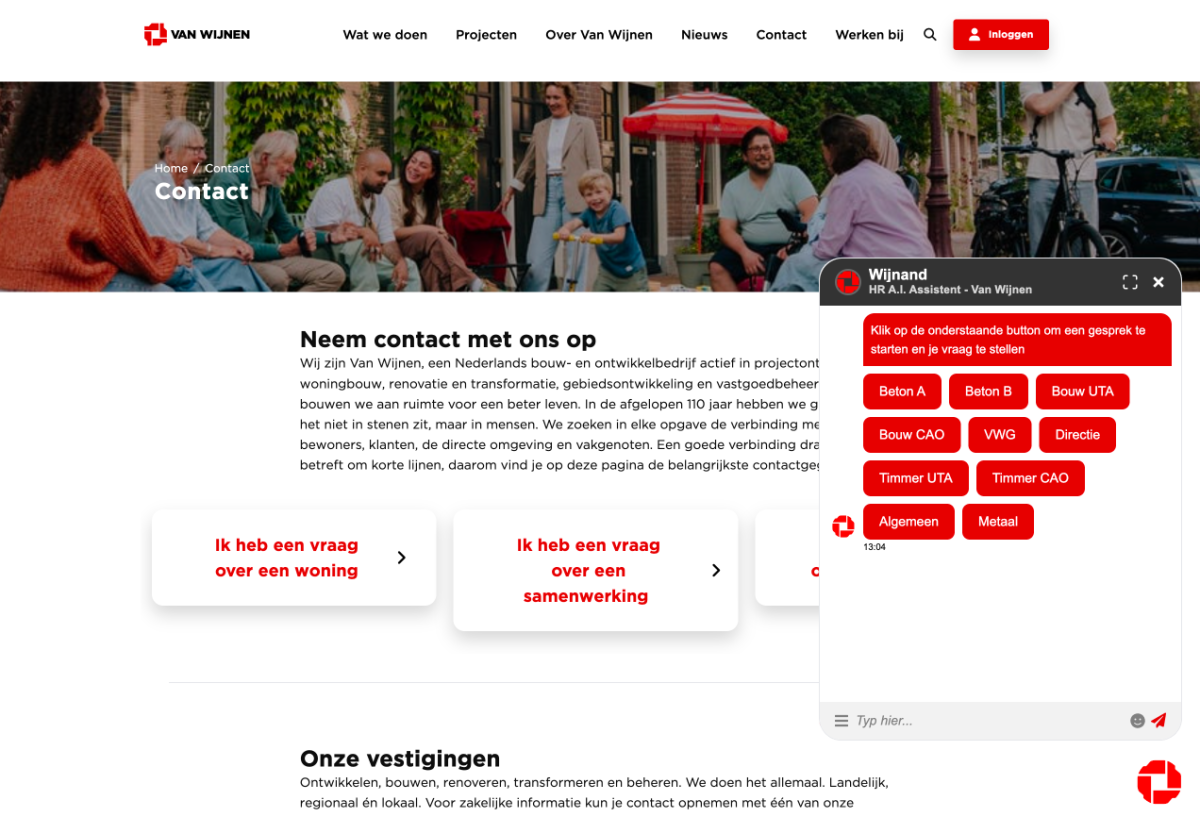
At Van Wijnen, this took shape in the development of an internal AI assistant for HR. The goal: to quickly help colleagues with first-line questions while simultaneously relieving HR teams.
“Many questions are currently handled via email or phone to the HR service center, or they end up with HR advisors and business partners,” Mitchell explains. “With an AI assistant, you can immediately address many of those initial questions.”
This means faster answers for employees and more room for HR professionals to focus on topics where personal contact, customization, and expertise are truly needed.
A complex issue requires a strong substantive foundation
Van Wijnen's AI assistant is not a simple chatbot with a single data source. Within the organization, there are various target groups, regulations, documents, collective labor agreements, and systems that are all relevant to answering questions correctly.
“We have many different sources and systems that contain information,” Mitchell explains. “What's important to us is that all that information can be intelligently connected. Safety is a crucial part of this: who is allowed to see what information from various sources, and what answer does someone receive based on their role within the organization?”
That is precisely where Van Wijnen saw great value in partnering with Conversed.ai. “What we appreciate is that Conversed.ai truly brings specialist expertise to the table. Not just in terms of technology, but also in how to integrate different systems and data sources into a solution that actually works in practice.”.
Building together with the organization
A striking aspect of the process at Van Wijnen is the way employees are involved early on. Instead of only testing just before going live, the HR team has involved other colleagues with the AI assistant at an early stage. By having them ask questions, the team receives feedback during the design and build phases.
“We deliberately asked people from the organization to help make the assistant smarter,” says Mitchell. “The request was very simple: ask questions and give feedback. This makes the AI assistant increasingly intelligent. By building together with the organization, we want to prevent an initial peak in usage followed by a decline. The main question is: how do you keep the assistant alive and how do you position it so that it becomes an obvious part of how people work?” According to Mitchell, this works well precisely because it fits Van Wijnen's culture.
“Our organization has a lot of curiosity and a strong can-do mentality. As a result, we get a lot of enthusiastic responses and also a lot of input.”
This immediately yielded valuable training data before going live.
Good training takes time - and it's worth it
Mitchell emphasizes that organizations should not underestimate the development of a good AI assistant.
“We might have thought we could pick up the pace at first,” he says. “But when you have multiple target groups and really want to achieve a certain level of quality, you have to take your time.”
His advice to other organizations is therefore clear: don't just think about the launch, but also about what is needed afterward.
“You shouldn't just think about how to go live, but also about how to keep it alive afterward and continue developing it. That ultimately makes the difference.”
He also found the training itself to be a positive experience.
“Reviewing and improving through the platform is very intuitive. We received many questions to review, but that is ultimately valuable, because you'd rather encounter those questions before going live than after.”
A strong collaboration with Conversed.ai
Mitchell is positive about the collaboration with Conversed.ai.
“In market research for an AI partner, Conversed.ai stands out,” he says. “Especially because you were at the table as specialists and are very strong in terms of subject matter expertise during discussions.”
Van Wijnen also saw the specialized approach during the development.
“We know our organization and our target audiences better than anyone. You then know how to translate that into a working AI agent. That combination works very well for us.”
According to Mitchell, the strength of the collaboration lay not only in technique, but precisely also in remaining sharp together on content, planning, and positioning.
“We really went through that process well together. As a result, we're not just building something technical, but something that also truly connects with our organization's practical needs.”
From HR Assistant to Broader Digital Colleague
For Mitchell, this is just the beginning. In the short term, he sees a lot of value in an AI assistant that functions as a smart HR colleague for frontline questions. But in the longer term, he also sees broader applications within the organization.
“The next step could be to open up multiple departments,” he says. “So that it's not just an HR assistant, but a broader digital colleague who can support in multiple domains.”
And it doesn't stop there.
“Ultimately, it would be great if such an assistant could actually handle things. For example, initiating a leave request or creating an IT ticket. Then you go from providing information to truly supporting processes.”
More room for the human side of HR
Although AI is capable of more and more, Mitchell doesn't believe the human aspect of HR will disappear. On the contrary.
“I actually think that AI makes the human side of HR more important,” he says. “By intelligently handling routine work, more time is created for personal development, team development, and organizational development.”
That is the core of the development for him as well.
“AI should primarily help create space for the work where people truly make a difference.”
With this vision, Van Wijnen is further developing an AI assistant with Conversed.ai that is practical, scalable, and future-oriented – and that helps colleagues to be supported faster, smarter, and better.


